
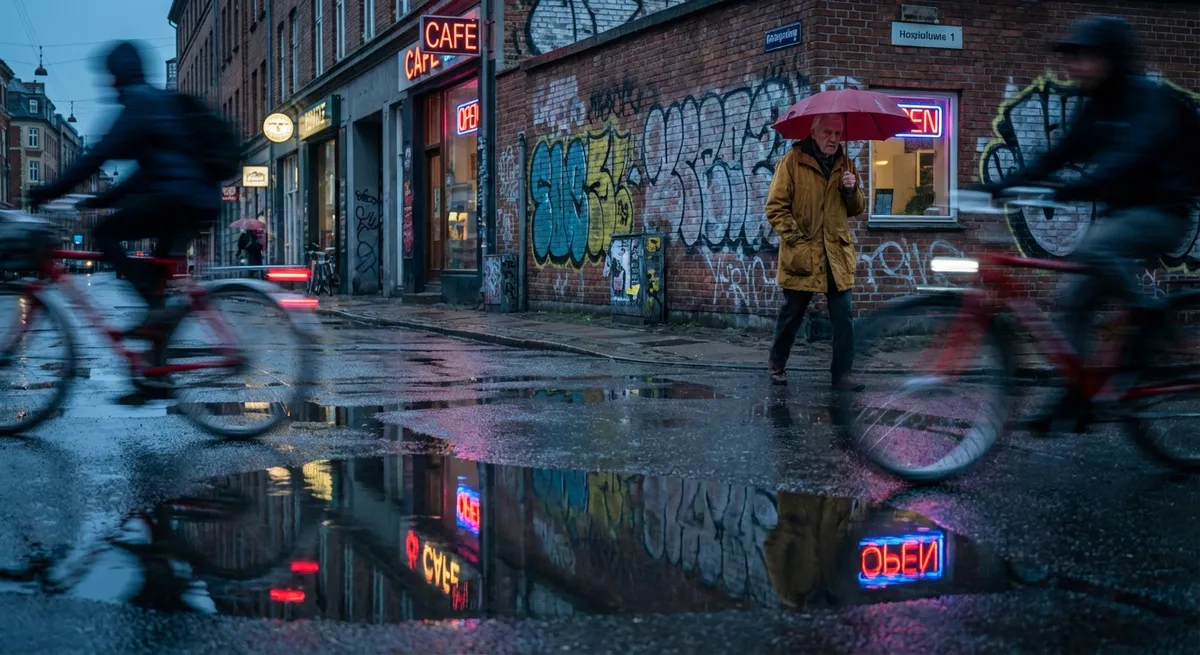
The street is a living stage: light changing by the minute, strangers drifting in and out of frame, stories unfolding at crosswalks and bus stops. Street photography isn’t about having the “perfect” city or the “perfect” camera—it’s about learning to see. When you start treating sidewalks, reflections, and passing glances as raw material for visual stories, every walk becomes a creative adventure. This guide will help you pair intuition with technique so you can step outside and return with images that feel alive.
Start With the Walk, Not the Camera
Before you worry about settings, learn to move through a place like a listener instead of a tourist. The more you notice, the more your photos gain depth.
Walk slower than usual. Let yourself wander off your routine path and pay attention to how light falls on walls, faces, and pavement. Listen for clues: the hiss of a bus braking, the chatter of a café, the echo of footsteps in an alley. These sounds often signal motion, interaction, or tension—prime material for photographs.
Try choosing a single micro-area—a single block, a bus stop, a market entrance—and spend 30–60 minutes there. Watch how people navigate that space. Where do they pause? Where do they hurry? Who looks up, who looks down? This observational warm-up trains you to anticipate moments instead of reacting too late.
Creative exercise: leave your camera in your bag for 15 minutes and “shoot” only with your eyes. Imagine framing scenes, deciding where you’d stand, when you’d press the shutter. Then take the camera out and see how closely you can capture the images you’ve already pre-visualized in your mind.
Set Your Camera to Stay in the Moment
Street photography rewards speed and readiness more than technical perfection. The idea is to set up your camera so it becomes almost invisible—so you can focus on people and timing instead of menus and dials.
A practical, flexible starting setup for daylight:
- Mode: Aperture Priority (A/Av) for speed with control
- Aperture: f/5.6–f/8 to keep enough of the scene sharp
- ISO: Auto ISO with max around 3200 (or 6400 on newer cameras)
- Minimum shutter speed: 1/250s to freeze walking motion, 1/500s if things are moving faster
- Focus mode: Continuous AF (AF-C/AI Servo) with a small or zone focus point
- Drive mode: Continuous low burst (2–5 fps) for short sequences without overshooting
- Metering: Evaluative/Matrix for most situations
This “set and forget” baseline means your camera adjusts exposure while you handle timing and framing. If your images are consistently too bright or too dark, use exposure compensation (+/-) rather than changing modes entirely.
In bright sun, you can push your shutter speed up to 1/1000s or faster to freeze mid-stride gestures, hair blowing, or cyclists in motion. At dusk or in shade, let ISO rise so shutter speed doesn’t drop below 1/160s—grain is usually a better trade-off than motion blur, unless blur is your intention.
Creative exercise: go out for one hour and don’t change your Aperture Priority base setup. Force yourself to solve problems with movement and framing instead of obsessive tweaking. Later, review which situations strained your settings and adjust your defaults for future walks.
Master Focus So You Don’t Miss the Moment
Many missed street photos are focus problems, not composition problems. In a world where everything moves, your focusing strategy has to be fast and forgiving.
For scenes with moderate movement, use AF-C/AI Servo with a small zone or cluster of focus points centered or slightly off-center. Keep that zone where you expect the subject’s face or torso to be. Pre-frame roughly, then track with small body movements rather than big camera swings.
When people are moving predictably (crossing a street, walking past a storefront at a steady distance), try zone focusing: switch to manual focus, choose a distance (say, 2–3 meters), and set your aperture to f/8. Use the distance scale on your lens (or an approximation) so that everything within that zone is sharp. Then you simply wait for people to cross into that invisible “sharpness zone” and shoot without delay.
At night or in low light, autofocus might hesitate. If your camera struggles to lock focus, choose a high-contrast target—an edge of a jacket, a sign, a car’s edge—and focus there while keeping the distance roughly the same as your subject.
Creative exercise: spend 30 minutes shooting only with zone focusing and f/8. Pick a distance (e.g., people passing at arm’s length). Stand in one place and capture people as they enter your sharpness zone. This will sharpen your timing and build confidence when things are moving quickly.
Work With Light the Way a Dancer Works With Music
Street photography lives and dies by light. On the same block, a scene can go from flat to magical just because a cloud moved and created a shaft of brightness or a pool of shadow.
In the middle of the day, when light is harsh, look for contrast instead of avoiding the sun. Search for hard-edged shadows on the ground or on walls. Position yourself so people walk through those bright patches or slice through contrasting shapes. Expose for the highlights (slightly underexpose if needed) to keep the bright areas from blowing out and let the shadows go deep and dramatic.
During golden hour, the light is softer and more forgiving. Place people between you and the sun to get rim light on their hair and outlines. Look for long shadows stretching across crosswalks and sidewalks—these can be as expressive as faces. Keep your shutter speed fast enough to avoid blur as the light drops; raise your ISO if needed.
At night, embrace artificial light. Neon signs, bus interiors, phone screens, and street lamps create pockets of glow. Shoot wide open (f/1.4–f/2.8 if your lens allows) and accept higher ISO (3200–6400+) to preserve the ambience. Let background lights blur into bokeh to give a cinematic feel.
Creative exercise: pick one kind of light—harsh midday sun, golden hour, or neon night—and dedicate an outing to it. Instead of chasing subjects randomly, chase how that specific light behaves: reflections, flares, silhouettes, or colors. Build a mini series of 10 images that all share that light character.
Compose With Curiosity, Not Rules
Street scenes are messy. Instead of forcing rigid rules, use them as gentle guides while you stay curious about layers, relationships, and edges.
Look for relationships: a person and a billboard that echo each other, a color on someone’s coat matching a storefront, a kid’s gesture mirroring a statue. These visual rhymes turn casual moments into striking frames. Scan edges of your frame for distractions like half-cut heads or stray poles; small shifts of your stance can clean up chaos.
Try working with layers: foreground, middle, and background all interacting. For instance, shoot through a café window (foreground reflections), with people inside (middle), and a street scene beyond (background). Use a slightly narrower aperture (f/5.6–f/8) to keep more layers readable.
Pay attention to negative space too. A lone figure on a wide, empty sidewalk can say more than a crowded intersection. Step back, include more environment, and see how scale and isolation tell their own story.
Creative exercise: choose a compositional “theme” for a walk—reflections, frames-within-frames (doorways, windows), or color repetition. Take at least 15 photos that explore that single idea. Constraints like this push you to see familiar places in fresh ways.
Approach Strangers With Respect and Intention
Street photography deals with real people, not actors. How you behave out there shapes your experience—and your images.
If you’re photographing someone in a way that feels intimate or close, consider offering a simple gesture of acknowledgment: a nod, a smile, or even a quick “Thank you.” Often, people respond with curiosity rather than suspicion. If someone seems uncomfortable, lower the camera and move on. No photo is worth making someone feel unsafe.
In some cultures or locations, it’s wise (and sometimes legally necessary) to ask permission, especially for children or when you’re lingering. Learn your local laws about photographing in public spaces; many countries allow it, but expectations and attitudes vary widely.
If you decide to ask, keep it friendly and honest: “Hi, I’m working on a personal project about city life—could I make a quick portrait of you here? The light is beautiful.” Having a simple, sincere explanation often disarms people. Show them the photo afterward if they’re curious, and offer to send it to them.
Creative exercise: set yourself a goal to ask three strangers for a portrait in one day. Expect some no’s and treat them graciously. This builds confidence, empathy, and a more collaborative approach to photographing people.
Turn Everyday Errands Into Micro Photo Missions
You don’t need to dedicate an entire day to practice. You can fold street photography into the life you already live.
Going to work or school? Leave 15 minutes early and assign that time a mission: “Only shoot reflections,” or “Only vertical frames.” Meeting friends downtown? Aim to arrive one train earlier and use that time for the station or the walk from the stop. Use your lunch break to explore just one alley you’ve never walked down.
Keep a small camera—or even your phone—in a crossbody bag or jacket pocket so it’s always within reach. If you’re using a phone, treat it like a serious tool: clean the lens, turn off distracting notifications, and learn how to lock exposure and focus (tap-and-hold on most modern devices). You’ll start accumulating a body of work from slivers of time you used to lose to scrolling.
Creative exercise: pick a routine you do at least three times a week—a commute, a dog walk, a grocery trip. For two weeks, bring your camera every time and make one deliberate photo on each outing. At the end, lay them out in sequence. You’ll see how your eye evolves and how familiar places slowly reveal new stories.
Shape Your Vision Through Editing and Reflection
The moment you click the shutter is only half the story; the way you choose, sequence, and process your photos shapes your voice.
After a walk, resist the urge to keep everything. Do a quick “first pass” selection: mark any image that instantly pulls you in, even if it’s technically imperfect. Then, after a short break, do a “second pass,” comparing similar frames and forcing yourself to choose only the strongest.
In editing software (or even a good mobile app), aim for subtle adjustments: tweak exposure, contrast, and color or convert to black and white if it enhances mood. Avoid over-saturating or over-sharpening; street photos often feel strongest when they stay close to the atmosphere you experienced.
Over time, look for patterns in your favorites. Are you drawn to solitude or crowds, color or monochrome, expressions or gestures? Noticing these patterns helps clarify your personal style and informs what you look for next time you’re out.
Creative exercise: create a “10-photo story” from your last month of shooting. Limit yourself to exactly ten images that, together, describe how your city feels right now. Sequence them so they have a beginning, middle, and end. Share that sequence rather than single out-of-context photos—you’ll learn a lot about yourself as a storyteller.
Conclusion
Street photography is not about being in the “right” city or owning a legendary camera. It’s about attention, patience, empathy, and the courage to press the shutter when something stirs you. With a thoughtful setup, a sharp eye for light and moments, and a few simple creative exercises, you can transform ordinary walks into quiet adventures in seeing.
Each time you step onto the sidewalk, you have a choice: rush through it, or move through it as an artist. Let the city speak. Listen with your eyes. And let your photographs become the echoes that carry those stories further than a single street ever could.
Sources
- [Magnum Photos – Learn: Street Photography](https://www.magnumphotos.com/learn/street-photography/) - Insight and practical tips from renowned Magnum photographers on working in public spaces
- [Leica Camera Blog – Zone Focusing Technique](https://leica-camera.blog/2016/04/01/zone-focusing-technique/) - Clear explanation of zone focusing and how to apply it in fast-moving situations
- [B&H Explora – The Ultimate Guide to Street Photography](https://www.bhphotovideo.com/explora/photography/tips-and-solutions/the-ultimate-guide-to-street-photography) - Technical and creative guidance, including camera settings and approach
- [American Society of Media Photographers – Legal FAQs: Street Photography](https://www.asmp.org/property-releases/) - Overview of legal considerations and rights related to photographing people in public in the U.S.
- [Harvard University – Seeing and Not Seeing (Harvard Gazette)](https://news.harvard.edu/gazette/story/2015/11/seeing-and-not-seeing/) - Discussion on perception and attention that parallels how photographers learn to notice the world