
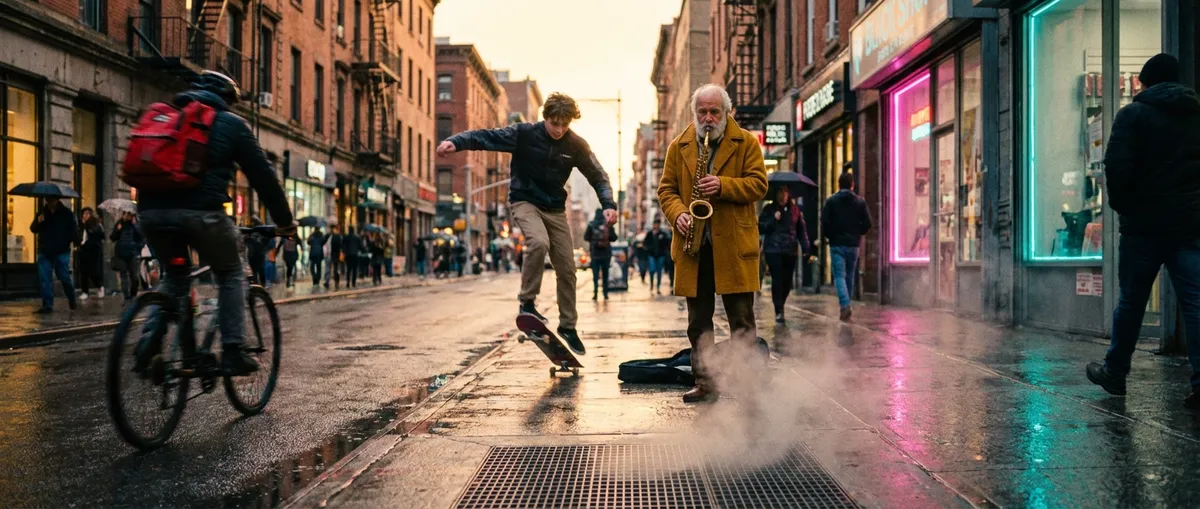
Street photography isn’t just about taking pictures—it’s about catching life mid‑sentence. It’s the unplanned handshake, the quiet stare at a bus stop, the neon reflection in a rain puddle nobody noticed but you. Whether you’re holding a smartphone or a full-frame camera, the streets are a living canvas, and you’re invited to paint with light.
This guide is your field notebook: practical camera settings, clear techniques, and creative exercises you can try today to make your images more intentional, emotional, and share‑worthy.
Seeing the Street: Training Your Eye Before You Lift the Camera
Before thinking about shutter speeds or lenses, start by learning to see.
Walk without shooting for 10–15 minutes. Notice patterns: repeated colors, similar gestures, or how people pause at crosswalks. Watch where light falls—on faces, building edges, and window reflections. Street photography is essentially visual eavesdropping.
Start to look for:
- Layers: Foreground, subject, background all telling one story.
- Juxtapositions: A serious billboard above someone laughing; a fancy boutique next to a worn-out bicycle.
- Rhythm: Repeated shapes like rounded windows, parked scooters, or crosswalk lines.
- Emotion and gesture: A raised hand, a hunched shoulder, a burst of laughter.
Do a “no-camera walk” once a week. Mentally frame photos as if your vision were a viewfinder. Ask: If this were a photo, where would I stand? What would I include or exclude? When you finally raise your camera, your mind will already be composing.
The Gear You Have Is Enough (But Here’s How to Make It Sing)
Street photography rewards speed, lightness, and invisibility more than megapixels.
Cameras
- Smartphone: Perfectly fine for street. Use tap-to-focus, lower exposure when highlights blow out, and shoot in burst mode for gestures and movement.
- Compact / Mirrorless / DSLR: Any will work. Prioritize:
- Fast autofocus
- Good high-ISO performance
- Customizable buttons for quick setting changes
Lenses
- 35mm equivalent (on full frame): Classic street focal length—close to how we naturally see.
- 28mm: Wider, great for environmental context and getting closer.
- 50mm: More intimate, flattering for portraits, slightly more distance from subjects.
If you’re unsure: start with a 35mm equivalent lens and stick with it for a month. Familiarity with one focal length builds faster instinct than swapping lenses constantly.
Minimal Street Kit Idea
- One small camera or smartphone
- One prime lens (28–35mm equivalent)
- Extra battery / power bank
- A small crossbody bag or jacket pocket
Light gear means less friction—and more shooting.
Street-Proof Camera Settings: Simple, Fast, Reliable
You want settings that let you react quickly and nail focus in changing conditions. Use these as starting points and tweak as you gain confidence.
Daylight Settings (General Street)
- Mode: Aperture Priority (A/Av) or Shutter Priority (S/Tv)
- Aperture: f/5.6–f/8
- ISO: Auto, capped around ISO 3200 or 6400 (depending on your camera).
- Shutter Speed
- For steady people: 1/250s
- For walking subjects: 1/500s
- For fast action: 1/1000s
- Focus Mode: Continuous AF (AF-C/AI Servo) with a small center focus point or zone.
- Drive Mode: Continuous low burst for peak moments.
Wide enough for light, deep enough for forgiving focus.
Quick Hack: The “Set and Forget” Zone Focus
Use this when you want to shoot without waiting for autofocus:
- Switch to Manual Focus.
On a wide lens (28–35mm), set:
- Aperture: f/8 - Focus distance: around 2–3 meters (6–10 feet) 3. Set ISO high enough to get 1/500s shutter speed (raise ISO if needed).
Now, anything roughly from about 1.5–5 meters (depending on lens and sensor) will be sharp. Just point and shoot.
Low Light / Night Street
- Mode: Shutter Priority recommended.
- Shutter Speed: 1/125s minimum for people; 1/250s if there’s quick movement.
- Aperture: Wide open (f/1.4–f/2.8 if your lens allows).
- ISO: Auto with a higher cap (e.g., ISO 6400–12800 depending on camera).
- White Balance: Auto (fix fine-tuning in editing later).
Embrace grain and contrast at night—it often adds character and mood.
Technique Breakdown: From Random Snapshots to Intentional Frames
1. Work the Scene, Don’t Chase It
When you see a promising spot—great light, a colorful wall, a strong graphic shape—stay put. Let the world walk into your frame.
- Choose your background and composition first.
- Lock in your exposure and focus settings.
- Wait for the right subject or gesture to appear.
This transforms you from hunter to fisherman, increasing your chance of a strong image.
2. Use Light Like a Director
Think of light as your main storytelling tool.
- Hard sunlight: Look for strong shadows, silhouettes, and high contrast.
- Position yourself so subjects walk in and out of light patches.
- Expose for the highlights to keep details in bright areas.
- Overcast skies: Soft, even light—perfect for faces and subtle emotion.
- Focus on expressions, gestures, and color rather than strong shadows.
- Backlighting: Shoot with the light behind your subject for glow and drama.
- Slightly underexpose to preserve details in bright areas.
Walk one street on the sunny side and then back on the shaded side—note how your story options change.
3. Get Closer (Then Closer Again)
Physical distance = emotional distance. Most compelling street photos feel immersed, not zoomed-in.
Try this:
- Start at a comfortable distance.
- Take a photo.
- Take two steps closer.
- Take another photo.
- Repeat until you feel nervous—that edge is where often the most alive images are.
Respect people and read body language. If someone looks uncomfortable, smile, gesture, and move on.
4. Compose With Intention
Keep composition simple and clean, even in a busy street.
- Look for:
- Leading lines: crosswalk stripes, railings, fences guiding the eye.
- Frames: doorways, windows, archways around your subject.
- Clean backgrounds: wait half a second for the clutter behind your subject to move.
Before pressing the shutter, ask: What is my subject? Can a stranger tell within one second? If not, reframe.
Creative Exercises to Sharpen Your Street Vision
Use these mini-assignments as “photo workouts” to build skill and style. Pick one per outing.
Exercise 1: The One Street Story
- Choose a single street or block.
- Spend 45–60 minutes there only.
- Goal: Tell the story of that street in 10 photos:
- 2–3 wide establishing shots
- 3–4 mid-distance human moments
- 3–4 details (hands, shoes, objects, reflections)
This limits your options and deepens your observation.
Exercise 2: Only Shadows & Silhouettes
- Shoot for an hour around strong light (early morning or late afternoon).
- Intentionally underexpose to get dark shapes and bright highlights.
- No faces needed—look for distinctive outlines, hats, bikes, dogs, architecture.
This trains you to see graphic shapes and light direction instead of just “stuff.”
Exercise 3: 24 Frames, One Prime Lens
- If you have a camera: Load a 24–36 exposure roll of film or pretend your digital camera has only 24 shots.
- If on phone: Limit yourself to 24 clicks—no deleting until you’re home.
- Use just one focal length (or don’t zoom).
This forces patience. Watch how you slow down and hesitate before pressing the shutter—and how your keepers improve.
Exercise 4: Color Hunt
Pick a color before you head out: red, yellow, blue, green.
- For 30–60 minutes, shoot only scenes where that color is a key element.
- It might be a jacket, a car, a storefront, or a traffic sign.
Back home, arrange the images into a color-based mini-series—perfect for a cohesive Instagram carousel or SnapFresco gallery.
Exercise 5: The Invisible Photographer
Practice blending in:
- Dress neutrally.
- Move slowly; avoid sudden camera-to-eye movements.
- Spend time in one location so people stop noticing you.
- Bring the camera to your eye early and keep it there as people pass; then press the shutter when the moment happens.
You’ll find that the quieter you are, the louder the stories become.
Sharing Your Street Work: From Memory Card to Community
A photo doesn’t reach its full life until someone else sees it.
Basic Editing Tips
- Crop lightly: Refine composition, but avoid overcropping if it kills quality.
- Adjust exposure & contrast: Aim for natural, but don’t fear strong contrast for drama.
- Color or B&W?
- Choose color when it adds meaning: neon signs, fashion, markets.
- Choose black and white when the story is about shape, gesture, or emotion.
Curate With Care
For social media or SnapFresco:
- Share series, not just single hits.
- Build mini-narratives: 5–10 images from the same location, color, or time of day.
- Add short captions that give context or emotion without over-explaining.
Think of each post as a tiny photo zine: a sequence, a rhythm, a mood.
Street Etiquette & Confidence: Shooting With Respect
Street photography lives at the intersection of curiosity and consent.
- Trust your instinct: If it feels wrong to shoot, it probably is. Lower the camera.
- Smile often: A genuine smile can dissolve tension.
- If someone notices:
- Nod or smile; sometimes show the photo.
- If they’re upset and ask you to delete, consider doing so—even if law is on your side. People matter more than any single image.
- Know your local laws: In many places, photographing in public is legal, but each country and city can differ; private property and sensitive locations may have restrictions.
Respect builds confidence. When your intentions are honest, people can usually feel it.
Conclusion
Street photography is the art of saying, “This happened, and it mattered”—even if it passed in three seconds and no one else saw it. With simple, reliable settings, a light kit, and a few creative exercises, you can transform daily walks into visual stories that feel alive and deeply human.
You don’t need permission from the city, from expensive gear, or from your inner critic. You just need to show up, pay attention, and press the shutter when your heart flinches.
The streets are talking. Take your camera, step outside, and start listening.
Sources
- [Magnum Photos – Street Photography](https://www.magnumphotos.com/theory-and-practice/a-brief-history-of-street-photography/) - Overview of street photography’s history and evolution from one of the most respected photo agencies.
- [Leica Camera Blog – Street Photography Tips](https://leica-camera.com/stories/street-photography-tips) - Practical advice and insights on technique and mindset from a brand deeply rooted in street photography culture.
- [Nikon USA – Master Street Photography](https://www.nikonusa.com/en/learn-and-explore/a/tips-and-techniques/master-street-photography.html) - Technical guidance on camera settings, composition, and etiquette tailored to street shooting.
- [National Geographic – How to Photograph Street Scenes](https://www.nationalgeographic.com/photography/article/how-to-photograph-street-scenes) - Expert tips on capturing authentic moments and working with light in public spaces.
- [B&H Explora – Zone Focusing for Street Photography](https://www.bhphotovideo.com/explora/photography/tips-and-solutions/zone-focusing-street-photography) - Clear explanation of zone focusing with examples and practical use cases for fast-paced street work.