
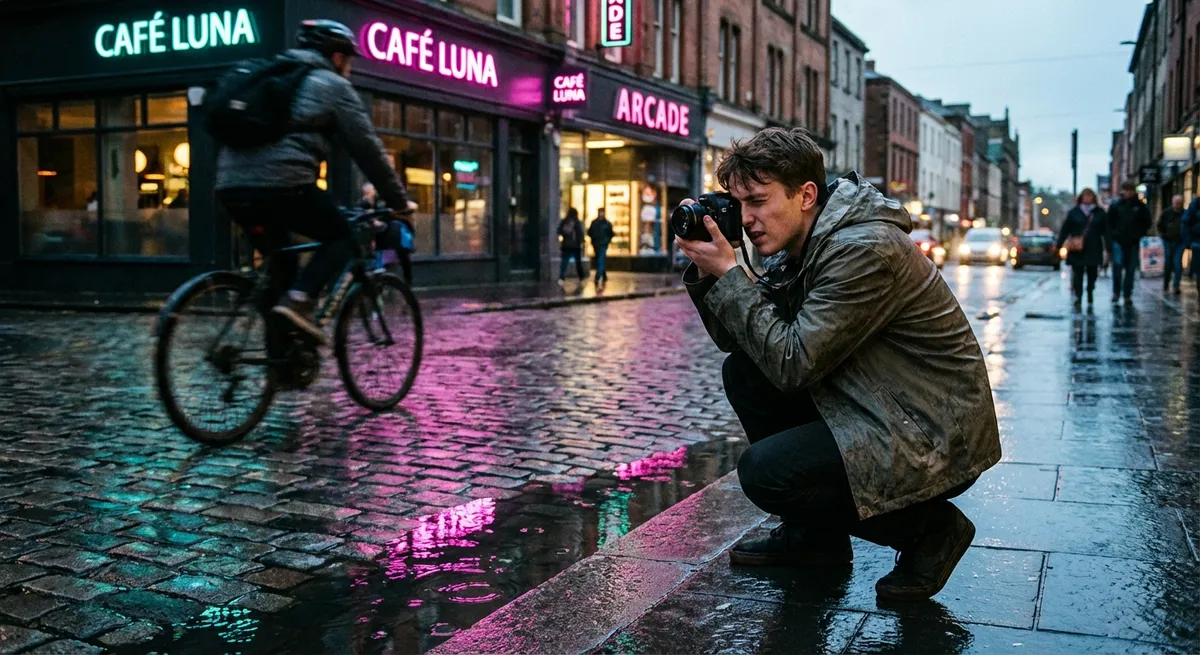
Every powerful photo starts long before you press the shutter. It begins the moment you lift the camera and decide what not to include in the frame. Composition is where technical skill and your inner storyteller finally meet—and that’s where the magic of photography lives.
Whether you’re shooting on a phone or a full-frame camera, these composition tips, settings suggestions, and creative exercises will help you see more intentionally, slow down, and create images that feel crafted—not accidental.
1. Start With the Story, Not the Rule
Before thinking about rules, ask: What is this photo really about? Is it the expression on someone’s face, the geometry of a building, the glow of sunset, or the chaos of a city street?
When you define the story first, composition becomes a set of choices that support that story:
- Move closer or farther to clarify what matters.
- Tilt the camera slightly or drastically to change the energy.
- Remove distractions from the frame instead of trying to “fix” them later.
- Use negative space to let your subject breathe and feel important.
Creative exercise:
Choose one subject (a person, a coffee cup, a tree, your bike). Take 20 photos, but before each shot, say out loud: “This photo is about…” and finish the sentence. Then adjust your framing to match that intention.
Camera tip:
Use Aperture Priority mode (A/Av) so you can focus on the story and depth of field while the camera handles shutter speed. Start at f/2.8–f/4 for portraits and f/5.6–f/8 for scenes with more detail.
2. Rule of Thirds: Your Fast-Track to Stronger Frames
The rule of thirds is like training wheels for good composition: simple, reliable, and surprisingly powerful. Visualize a grid dividing your frame into nine equal rectangles. The most compelling areas are where those lines intersect.
Placing your subject on one of these intersections creates balance and tension. Horizons that sit on the top or bottom third feel more cinematic than when they slice the frame in half. Eyes on the upper-third line immediately draw attention; a tree or building lining up with a vertical third gives structure to your image.
Creative exercise:
Turn on the grid in your camera or phone settings. Spend an hour shooting only with the rule of thirds in mind. Put:
- Horizons on a third
- Faces on a third
- Strong verticals on a third
Later, look at the images and note which placements feel most natural to you.
Camera tip:
To keep things sharp when reframing off-center, use a single focus point. Set it over your subject (rather than focusing in the middle and recomposing) to avoid unwanted softness, especially at wide apertures like f/1.8–f/2.8.
3. Leading Lines: Guide the Eye Like a Director
Leading lines are visual paths that pull your viewer into the frame and toward your subject. Think roads, fences, shorelines, staircases, bridges, shadows—anything that naturally flows through the scene.
When you use them intentionally, you become a director, guiding attention exactly where you want it to go. Diagonal or converging lines add energy and depth, while horizontal lines calm the image. Lines that begin at the bottom of the frame invite the viewer to “walk into” the photo.
Creative exercise:
Spend a photo walk hunting only for lines. For each scene:
- Find at least one clear leading line.
- Place your subject where those lines point.
- Experiment from low and high angles to change how strong the lines appear.
Camera tip:
Shoot in Shutter Priority mode (S/Tv) if you’re including moving subjects along your lines (people, cars, waves).
- Use 1/500s or faster to freeze motion.
- Drop to 1/60–1/125s if you want a bit of motion blur along your lines for dynamic energy.
4. Fill the Frame vs. Embrace the Space
Two opposing approaches can both be powerful: filling the frame and using negative space.
- Fill the frame when you want intensity, detail, and intimacy. Get closer until your subject dominates the composition. This works beautifully for portraits, textures, and details.
- Negative space (empty or simple areas like sky, walls, water) creates quiet, mood, and focus. It’s especially strong when you want your subject to feel small, lonely, free, or contemplative.
Ask yourself what emotion you want, then choose your approach.
Creative exercise:
Pick one subject. Shoot:
- A tight frame where the subject fills almost everything.
- A wide frame where the subject takes 10–20% of the image, surrounded by clean space.
Compare the emotional impact of each and note which you’re more drawn to.
Camera tip:
When filling the frame with a person, try 50mm–85mm on a full-frame camera (or 35mm–50mm on APS-C) at f/2–f/2.8 for flattering background blur. For negative space, stop down to f/5.6–f/8 to keep more of the scene in focus and recognizable.
5. Balance, Symmetry, and the Power of Imperfection
Your viewer’s eye is constantly weighing visual “weight”: bright areas, faces, text, color, and contrast all feel heavier than muted parts of the frame. Good composition balances that weight so the image feels stable—or intentionally off-balance.
- Symmetry (mirrored reflections, centered architecture, perfect horizons) feels calm, formal, and satisfying.
- Asymmetry with a strong subject on one side and a smaller “counterweight” on the other feels more dynamic and alive.
You don’t always need perfect balance; tipping the scale creates tension and drama. But ask: Does the image feel anchored somewhere, or is my viewer’s eye lost?
Creative exercise:
Find a location with strong symmetry (a hallway, a bridge, a reflection in water or glass).
- First, shoot it perfectly symmetrical with your subject dead-center.
- Then break the symmetry: shift the subject slightly off-center or add a second element to one side.
See how the mood changes.
Camera tip:
Symmetry demands precision. Turn on the electronic level in your camera if available, or use the on-screen grid to keep lines straight. Use f/8–f/11 for architecture so your symmetrical details stay sharp front to back.
6. Depth: Turn Flat Scenes Into 3D Stories
Photography is two-dimensional, but our brains love depth. You can create it with foreground, middle ground, and background elements that layer your story.
- Add something close to the lens (a leaf, railing, doorway) as a soft foreground.
- Place your main subject in the middle ground.
- Use the background to add context—mountains, city lights, interior spaces.
Even a simple scene becomes cinematic when it has layers.
Creative exercise:
Shoot the same scene three ways:
- With no foreground (just subject and background).
- With a subtle foreground element.
- With a bold foreground element taking up 20–30% of the frame.
Notice how the sense of depth and immersion changes.
Camera tip:
Depth is about both composition and focus. Use f/4–f/5.6 so your subject is clearly sharp while the foreground and background are gently blurred. Use back-button focus or a single AF point on your subject to keep control in busy layers.
7. Light as a Compositional Tool (Not Just Exposure)
Light doesn’t just expose your scene; it shapes it. Pay attention to how light and shadow carve out forms and guide attention.
- Side light (from a window or low sun) adds texture and depth—great for portraits and objects.
- Backlight (light behind your subject) creates silhouettes, halos, and drama.
- Soft, diffuse light (cloudy days, open shade) simplifies contrast and lets your composition and color really shine.
You can compose with light by placing your subject in a brighter or darker area than the background, creating a natural spotlight within the frame.
Creative exercise:
Pick one room with a single window or one outdoor spot at golden hour. Move your subject in a circle around the light source:
- Facing the light
- At 45°
- At 90° (side light)
- Back to the light
Photograph at each angle and look at how the shapes, mood, and lines change—even though you never changed your location.
Camera tip:
Use spot or center-weighted metering for tricky light (backlight, strong contrast) so your camera exposes for your subject, not the whole scene. Adjust exposure compensation:
- +0.7 to +1.3 for backlit subjects.
- –0.3 to –1 when your subject is in bright light against a dark background.
8. Minimal Gear, Maximum Intention: Settings That Support Composition
The best composition advice is useless if you’re constantly fighting your settings. Simplify your setup so the tech supports your creativity.
For everyday creative shooting:
- Mode: Aperture Priority (A/Av) for most scenes; Shutter Priority (S/Tv) for motion.
- Aperture:
- Portraits / subject isolation: f/1.8–f/2.8
- Street / travel: f/4–f/5.6
- Landscapes / architecture: f/8–f/11
- ISO:
- Daylight: 100–400
- Indoors / evening: 800–3200 (higher if your camera handles noise well)
- Focus mode:
- Still subjects: Single-shot AF (One-Shot / AF-S)
- Moving subjects: Continuous AF (AI-Servo / AF-C)
- Drive mode:
- Single shot for deliberate composition.
- Burst for fast-moving action, then pick the best frame later.
Creative exercise:
Dedicate one entire outing to a single focal length (a 35mm or 50mm prime, or lock your zoom and don’t touch it). This limitation forces you to move your feet, change perspective, and truly compose instead of relying on zooming.
9. Daily Composition Drills to Sharpen Your Eye
Like drawing or playing music, composition improves fastest with small, consistent practice. Turn it into a daily creativity workout:
- The 5-Frame Story:
Tell a mini-story in five images:
1) establishing wide shot,
2) medium,
3) close-up,
4) detail,
5) closing image.
Think like a filmmaker.
- Shape Hunt:
Spend 30–60 minutes looking only for one visual element: circles, triangles, reflections, or shadows. Compose every frame around that chosen element.
- One Color Challenge:
Choose a color (red, blue, yellow) and build a cohesive set of 10 images where that color is clearly part of the composition.
- Silent Crop Review:
After each shoot, pick 5 images and experiment with different crops: square, 16:9, vertical, tighter/looser. Study which crops strengthen the composition and why.
These exercises build instincts so that, over time, good framing becomes automatic and you’re free to focus on timing, emotion, and light.
Conclusion
Composition is not about memorizing rules; it’s about learning to see with intention. The lines you choose, the space you leave, the light you shape—these are the brushstrokes of your visual voice.
Every time you raise your camera, you have a chance to decide: What matters in this moment?
Let that answer guide where you stand, what you include, and what you let fall outside the frame.
Practice the techniques, run the exercises, experiment with your settings—but most of all, stay curious. The world is already full of stories. Your job is to frame them in a way only you can.
Sources
- [Nikon Learn & Explore – Composition Basics](https://www.nikonusa.com/en/learn-and-explore/a/tips-and-techniques/basics-of-photography-composition.html) - Overview of core composition principles with visual examples
- [Canon USA – Understanding the Rule of Thirds](https://www.usa.canon.com/shop/en/catalog/understanding-the-rule-of-thirds) - Explains how to use the rule of thirds effectively in different types of photography
- [Cambridge in Colour – Depth of Field & Aperture](https://www.cambridgeincolour.com/tutorials/depth-of-field.htm) - In-depth look at how aperture and depth of field influence visual focus and layering
- [Harvard Digital Photography Guide](https://projects.iq.harvard.edu/files/digitalimaging/files/digital_photography.pdf) - Educational PDF covering exposure, composition, and camera controls from an academic perspective
- [National Park Service – Night Sky Photography Tips](https://www.nps.gov/articles/night-sky-photography-tips.htm) - Practical camera setting suggestions and compositional advice for low-light and night scenes