
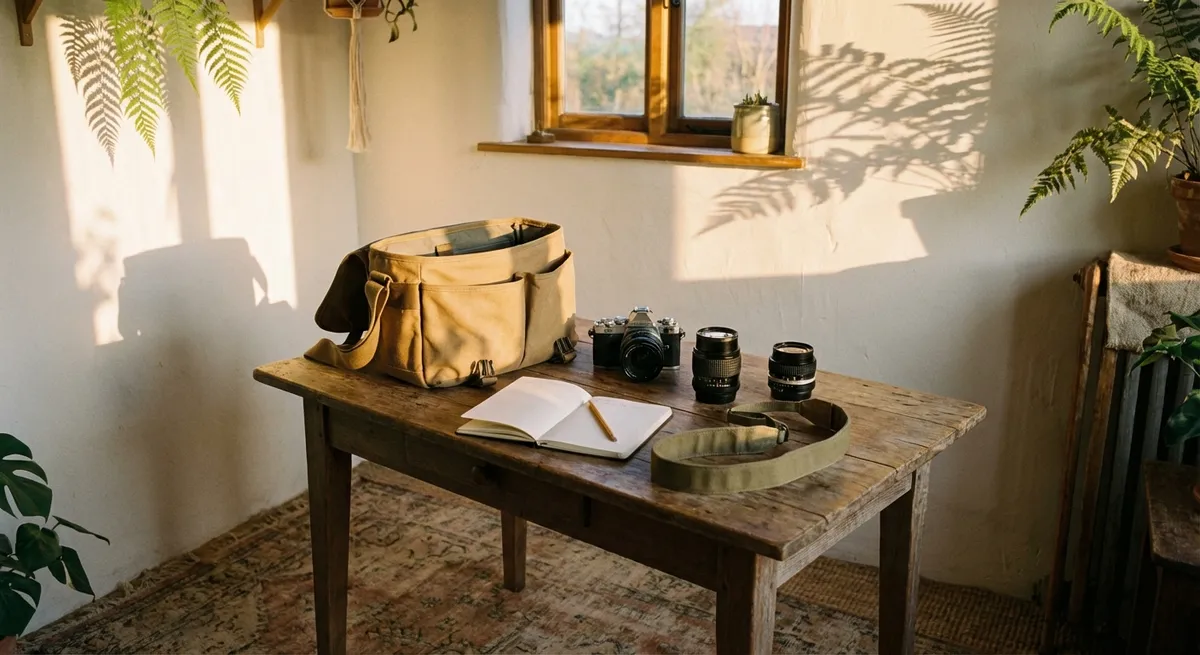
Your best photos won’t come from owning the most gear. They’ll come from knowing exactly what you carry—and why. A minimalist camera bag isn’t about doing less; it’s about removing everything that dulls your attention, so your curiosity and timing can do the heavy lifting.
Think of your kit as a travel companion for your ideas. Every item should earn its place by making one of three things easier: seeing, deciding, or creating. Let’s build a lean setup that works with your style instead of weighing it down—and then put it to the test with concrete settings, techniques, and creative exercises you can try on your next walk out the door.
Start With a Question, Not a Shopping Cart
Before thinking about brands or specs, start with the only question that matters: What do I want to photograph more of this year?
If your answer is “a bit of everything,” that’s okay—but let’s break it down. Are you more drawn to quiet moments with one person, big scenes that show a sense of place, or tiny details most people miss? Your honest answer will shape your core kit:
- If you love people and emotions, you’ll lean toward a fast prime lens and responsive autofocus.
- If you love places and mood, a wide-to-normal zoom and good dynamic range will matter more.
- If you love details and textures, close-focusing ability and stabilization will be your allies.
A minimalist bag usually centers on one camera body and one lens you trust blindly. From there, you add only what meaningfully expands how you shoot—not just what looks cool in a flat-lay photo. Ask of every piece of gear: Does this help me notice more, move better, or tell the story more clearly? If not, it stays home.
Choose a Body That Disappears in Your Hands
The “best” camera is the one that fits your hands, your eyes, and your habits so well that you stop thinking about it. Specs matter—but only in the context of how you actually shoot.
Here’s how to evaluate a camera body for a minimalist kit:
- Ergonomics: Can you change aperture, shutter speed, and ISO without taking your eye from the viewfinder? If not, you’ll miss moments.
- Viewfinder or screen: If you shoot mostly outdoors in bright light, a good viewfinder is gold. If you prefer waist-level and low-angle shots, a tilting screen helps your creativity.
- Low-light / high ISO: If you love evenings, interiors, and available light, test how clean files look at ISO 3200–6400 and how easy they are to clean up in editing.
- Autofocus behavior: Watch how it tracks subjects moving toward you. For portraits or street moments, eye/face detection that actually works is more useful than a few more megapixels.
For most photographers, these simple starting settings will give you confidence while you learn your camera’s personality:
- Everyday daylight (walk-around):
- Mode: Aperture Priority (A/Av)
- Aperture: f/4–f/5.6
- ISO: Auto, max 3200
- Exposure Comp: Start at 0, nudge to +0.3 or +0.7 if your images look too dark
- Low light indoors:
- Mode: Aperture Priority
- Aperture: f/1.8–f/2.8 (if your lens allows)
- ISO: Auto, max 6400 or 8000
- Exposure Comp: +0.3 to brighten shadows and skin tones
- Moving subjects (kids, pets, street):
- Mode: Shutter Priority (S/Tv)
- Shutter Speed: 1/500–1/1000 sec
- ISO: Auto, max 6400
- AF: Continuous (AF-C / AI-Servo), subject tracking on if available
Set these once, then spend an entire day focusing only on what’s in front of you. The less you fight menus, the more you’ll notice fleeting expressions, changing light, and subtle gestures.
The One-Lens Philosophy: Pick Your Focal Length Story
A minimalist kit thrives when you commit to a single focal length for a while. Every focal length tells a slightly different kind of story.
Here’s how to think about three classics:
- 35mm (full-frame) / ~23mm (APS-C): Feels close to how we see. Great for environmental portraits, everyday life, travel, and storytelling. You include context.
- 50mm (full-frame) / ~35mm (APS-C): A bit tighter and more intimate. Great for portraits, details, and scenes where you want less clutter.
- 28mm or wider (full-frame) / ~18mm (APS-C): For bold, immersive scenes, architecture, and dramatic foregrounds. Demands that you move your feet and get close.
If you prefer flexibility or shoot for clients, a 24–70mm (or equivalent) zoom can still fit a minimalist philosophy, as long as you resist zooming from habit and instead choose purposeful focal lengths.
Try these starting aperture choices:
- Story-rich scenes and groups: f/4–f/5.6 for more of the scene in focus.
- Isolated subjects and portraits: f/1.8–f/2.8 when you want soft backgrounds and subject separation.
- Landscapes or architecture: f/8–f/11 for sharpness front to back.
The magic isn’t in having every focal length. It’s in learning what your chosen lens does to distance, scale, and emotion—and then using that on purpose.
Essential Accessories That Actually Matter
Minimalist doesn’t mean bare. It means intentional. A small set of accessories can dramatically extend what your camera can do without adding mental clutter.
Consider these high-value essentials:
- A fast, reliable memory card: Look for a reputable UHS-I or UHS-II card from brands like SanDisk or Lexar. Format in-camera before big shoots, and carry a spare.
- One extra battery: Enough to get you through a long day without the anxiety of a dying camera mid-moment.
- A lightweight strap or wrist strap: Comfort matters. You’re more likely to carry your camera if it feels good to wear.
- A compact cleaning kit: A rocket blower, microfiber cloth, and a few pre-moistened lens wipes keep fog, dust, and fingerprints from dulling your work.
- Optional: A tiny tabletop tripod or clamp: For self-portraits, long exposures, timelapses, or low-light city scenes without a full-size tripod.
Skip items that duplicate the same function (three lenses that all “sort of” do the same thing, five filters you barely use). Every decision you remove in the field frees up energy for creativity.
Camera Settings as Creative Language, Not Homework
Once your kit is simple, your settings become a creative language instead of a test. You don’t need to master everything; you need to master a few go-to moves you can call on without hesitation.
Your “clarity” trio: aperture, shutter, ISO
- Aperture = depth of field + mood
- Use wide apertures (f/1.4–f/2.8) to:
- Highlight one person in a busy place
- Turn clutter into soft color and shape
- Emphasize emotion over environment
- Use mid apertures (f/4–f/8) to:
- Tell a story about a person and their space
- Photograph small groups
- Keep key elements readable without everything being razor sharp
- Use narrow apertures (f/11–f/16) to:
- Emphasize structure, patterns, or vast scenes
- Shoot landscapes and cityscapes with deep focus
- Shutter speed = motion
- 1/1000–1/2000: Freeze fast action (sports, jumping, birds).
- 1/250–1/500: Everyday movement (walking, casual moments).
- 1/60–1/125: Handheld still subjects (portraits, interiors).
- 1/4–1/30: Intentional blur (traffic light trails, rivers, crowds).
- ISO = grain vs. cleanliness
- Keep ISO low (100–400) when light is plentiful and you want maximum detail.
- Raise ISO (800–6400) with no shame when it means keeping your shutter speed fast enough to avoid blur.
Lean into the grain in low light if it supports the mood. A slightly noisy photo that feels alive is better than a technically clean one that never happened because your shutter was too slow.
Three Creative Exercises With a Minimal Kit
Use your stripped-down bag to sharpen how you see. These exercises are built to work with just one camera and one lens.
1. The Distance Experiment
Pick a single focal length (say, 35mm) and spend an afternoon shooting only three distances:
- Close: Fill the frame with a face, object, or texture.
- Medium: A person or subject with a bit of environment.
- Wide: The whole scene with plenty of surroundings.
For each subject, deliberately take those three versions. Use:
- Aperture Priority
- f/4 as your baseline
- ISO Auto, max 3200
Later, compare the triplets. How does the story change when you step in or step back? You’ll quickly feel how your lens “speaks” at each distance.
2. The Shutter-Speed Story
Find a moving subject: a fountain, traffic at night, passing trains, or even a friend walking.
Set up like this:
- Shutter Priority
- ISO Auto, max 6400
- Frame the same composition and shoot at:
- 1/1000 sec
- 1/125 sec
- 1/15 sec
- 1/4 sec (use a wall, railing, or tiny tripod for stability)
You’ll see how motion can be frozen, softened, or turned into streaks. Ask yourself for each version: Which one feels more true to how this moment felt? That answer will guide your choices next time.
3. The Single-Light Hunt
Leave flash and extra lights at home. Your tools are your camera, your chosen lens, and whatever light the world is offering.
Pick one of these simple settings based on time of day:
- Golden hour (early morning / late afternoon):
- Aperture Priority, f/2.8–f/4
- ISO 100–400
- Exposure Comp: +0.3 for warmth on skin tones
- Overcast day:
- Aperture Priority, f/2–f/2.8
- ISO 400–1600
- Exposure Comp: +0.3 to +0.7 to keep the scene from looking dull
Now spend an hour only looking for how light falls:
- On faces near windows
- Across building edges
- Through trees
- Reflecting from walls, pavement, water, or cars
Shoot the same subject when it’s front-lit, side-lit, and backlit. Your gear is simple; your job is to let light become the most interesting character in the frame.
Protect Your Work: A Minimal Backup Habit
Minimalism includes your digital workflow. You don’t need a complicated system—just one you’ll actually follow.
Adopt a “3-2-1” mindset in the simplest possible way:
- 3 copies of your photos:
- Your computer
- An external hard drive
- A cloud backup or online service
- 2 different types of storage: For example, computer + external drive, not just two folders on the same laptop.
- 1 copy off-site or in the cloud: In case of theft, loss, or damage at home.
Practical minimalist routine:
- After each shoot, import to a dated folder on your computer.
- Once a week, plug in an external drive and back up that week’s work.
- Use an automated cloud backup service that runs in the background so you don’t have to remember.
Your camera gear creates the images, but your backup habit protects the years of seeing and learning that went into making them.
Conclusion
A minimalist camera bag isn’t about restriction—it’s about freedom. When you carry just enough gear to stay curious and confident, you move faster, react quicker, and notice more. You stop worrying about what’s in your bag and start asking: What’s unfolding in front of me right now?
Choose one body that disappears in your hands, one lens whose look you know like a friend’s voice, and a few honest, useful accessories. Then commit to learning a handful of core settings and techniques so well that they fade into the background.
From there, it’s simple: step outside with your lean kit, try the exercises, and let your attention do the work. The fewer things you carry, the more space you make for the one thing no one else can pack into their bag—your way of seeing.
Sources
- [National Institute of Standards and Technology (NIST) – Digital Data Backup Guidelines](https://www.nist.gov/itl/smallbusinesscyber/guidance-topic/data-protection) - Provides foundational best practices for data protection and backup strategies, inspiring the simplified 3-2-1 backup approach.
- [Nikon USA – Understanding Exposure: Aperture, Shutter Speed, and ISO](https://www.nikonusa.com/en/learn-and-explore/a/tips-and-techniques/understanding-exposure-aperture-shutter-speed-and-iso.html) - Clear explanation of the exposure triangle and how each setting affects your images.
- [Canon Learn – How to Choose a Lens](https://snapshot.canon-asia.com/article/en/how-to-choose-a-lens) - Breaks down different focal lengths and their uses, supporting the one-lens philosophy and lens selection guidance.
- [Sony Alpha Universe – Autofocus Settings Guide](https://alphauniverse.com/stories/how-to-set-up-your-sony-camera-for-fast-action-and-sports/) - Practical autofocus configuration insights for moving subjects, applicable across brands.
- [Harvard University – Digital Preservation and Cloud Storage](https://library.harvard.edu/services-tools/digital-preservation) - Discusses principles of digital preservation and the role of redundant storage, reinforcing the importance of off-site and cloud backups.