
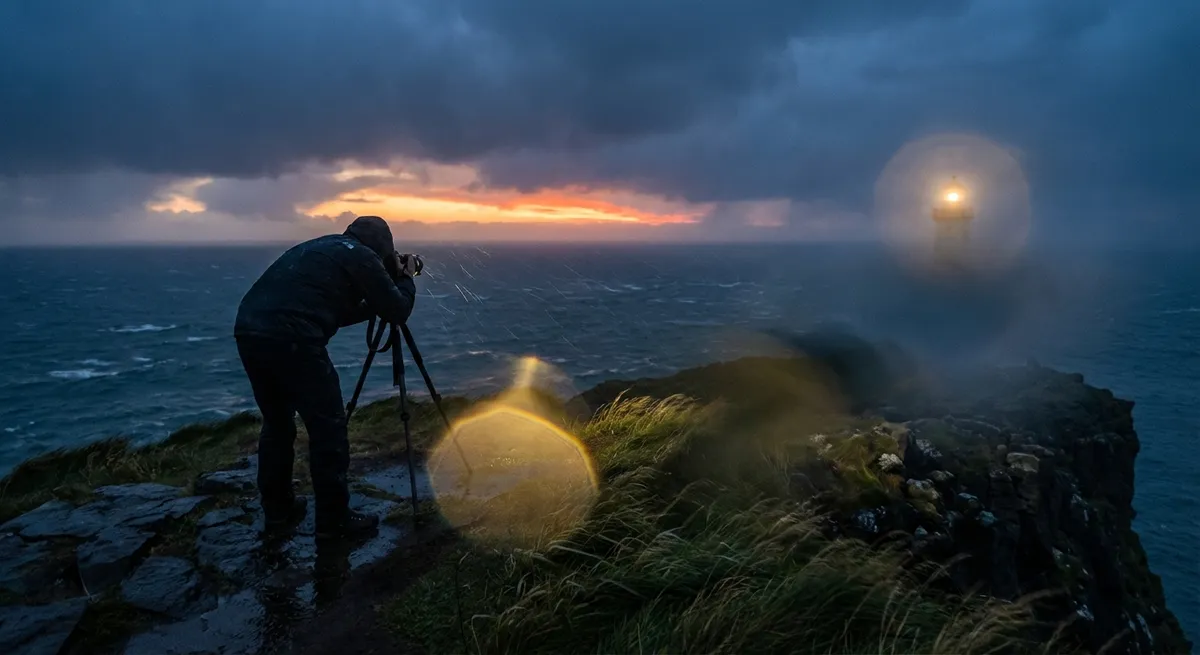
Landscape photography isn’t just about pointing a camera at a pretty view. It’s about listening to the weather, reading the sky, and translating shifting light into images that feel alive. The most memorable landscapes aren’t taken on perfect blue-sky days—they’re born in the in-between moments, when fog rolls in, storms break, or the sun burns through a low bank of clouds.
This is your invitation to step into those moments with intention. In this guide, we’ll explore how to work with weather and changing light, dial in practical settings, and use creative exercises that help you turn any landscape—dramatic or quiet—into a photograph that breathes.
Learning to Read the Sky (Before You Lift the Camera)
Before you think about shutter speeds or apertures, think in terms of mood. The weather is your first collaborator.
Spend five minutes just watching:
- Where are the brightest patches of sky?
- Are shadows hard-edged or soft and hazy?
- How fast are clouds moving?
- Is the air clear, dusty, humid, misty?
These answers will hint at your approach:
- Clear sunrise/sunset: Strong color gradients, crisp edges, high contrast. Great for bold silhouettes and graphic shapes.
- Overcast: Soft, forgiving light with subtle tones. Ideal for forests, waterfalls, and scenes with lots of detail.
- Fog and mist: Natural painter’s brush. Simplifies chaos, isolates subjects, and adds mystery.
- Stormy skies: High drama. Brooding clouds, streaks of light, fast-changing contrast—ideal for epic, cinematic frames.
A simple exercise: the next time you head out, leave your camera in the bag for the first ten minutes. Walk, look, and describe the light to yourself as if you were writing it into a book: “Cool and silvery,” “thick and muted,” “split between gold and shadow.” Then decide what kind of story you want your photo to tell before you set your exposure.
Building a Flexible Exposure “Base Camp”
Weather changes fast, so you need a reliable starting point—an exposure “base camp” you can tweak in seconds.
A solid all-purpose starting setup
For most outdoor landscapes in decent light:
- Mode: Aperture Priority (A/Av)
- Aperture: f/8–f/11 (sharpness and depth of field)
- ISO: 100–200 (cleanest image)
- Metering: Evaluative/Matrix
- Drive mode: Single shot or low-speed continuous
- Focus mode: Single-shot AF (One-Shot / AF-S)
- Focus area: Single point or small zone
From here, adjust based on the light’s behavior:
- If your sky keeps blowing out: dial -0.3 to -1 EV exposure compensation.
- If your shadows are too deep and murky: try +0.3 to +0.7 EV.
- If wind is moving leaves or grass: switch to Shutter Priority, aim for 1/250s or faster, and let ISO float higher.
Think of Aperture Priority + exposure compensation as a partnership: you choose depth of field and mood, the camera handles the rest, and you nudge it in the direction you want.
Chasing Subtle Light: Overcast & Foggy Days
Soft, gray light can feel “flat” at first glance, but it’s a quiet superpower. It reveals fine textures—moss, wet rock, foliage—without harsh shadows.
Settings for soft light
- Mode: Aperture Priority
- Aperture: f/8–f/11 for scenes; f/4–f/5.6 if you want a softer background
- ISO: 100–400 (bump up if it’s very dim)
- Shutter speed target: 1/80s or faster handheld; slower if on a tripod
- White balance: Cloudy or Shade to add warmth, or Auto if you’ll fine-tune in editing
In fog or low contrast, autofocus can hunt. Use:
- Single AF point and focus on a strong contrast edge (like a tree trunk against fog).
- Or switch to manual focus and use your camera’s focus magnification or peaking (if available).
Creative exercise: “Layers in the Mist”
- Find a foggy road, lakeshore, or forest path.
From a fixed spot, create three photos:
- One emphasizing the nearest layer (branches, rocks, reeds). - One emphasizing the middle layer (a tree or hill partially veiled in fog). - One emphasizing the deepest layer you can still see (a faint distant line of trees or a hill). 3. Review them side by side. Notice how fog naturally “paints” depth by reducing contrast and saturation the further you look. Use that to guide future compositions.
Harnessing Drama: Storms, Breaks in the Clouds, and Big Skies
Storm light is wild and theatrical—a dark, textured sky with sudden shafts of brightness punching through. This is when landscapes feel like movie stills.
Settings for storm drama
- Mode: Manual or Aperture Priority
- Aperture: f/8–f/11
- ISO: 100–400
- Shutter speed: 1/125s or faster (clouds move, rain moves, you move)
- Metering: Evaluative/Matrix, but watch your histogram
Because contrast is extreme, it’s easy to blow out highlights. Use:
- Exposure compensation: start at -0.7 EV to protect bright clouds.
- Highlight Alert (“blinkies”): if your camera has this, enable it and adjust until only the brightest specular areas blink.
Composition moves for stormy skies
- Put the horizon low when clouds are the hero.
- Anchor the frame with a strong foreground (a rock, tree, or building) to give scale to the sky.
- Look for light paths—bands of brightness hitting fields, hills, or water.
Creative exercise: “Two-Sided Story”
During changeable weather (before/after a storm):
- From a single location, shoot one image exposing for the land, letting the sky go brighter than usual.
- Then shoot a second image exposing for the sky, letting the land fall into deep shadow or silhouette.
- Compare them: which conveys the emotion of that moment better? This teaches you that “correct” exposure is less important than emotional exposure.
Walking the Edge of Day: Blue Hour and Night Landscapes
When the sun slips below the horizon, the world doesn’t switch off—it shifts to deep blues, subtle gradients, and tiny points of artificial light.
Blue hour landscapes (pre-dawn & post-sunset)
- Tripod: Strongly recommended.
- Mode: Aperture Priority or Manual
- Aperture: f/8–f/11
- ISO: 100–400 for clean files
- Shutter speed: often several seconds (1–30s)
- White balance: Daylight for natural blues; Tungsten/Incandescent for a cooler, more dramatic look.
Use a 2s self-timer or a remote release to avoid shakes. Turn on long exposure noise reduction if your camera offers it and you’re not in a hurry.
Night skies & stars
For stars as points (not trails), a good starting rule is the “500 rule”:
- Maximum exposure time ≈ 500 / focal length (full-frame equivalent)
- 24mm lens on full frame: 500 / 24 ≈ 20s
- 24mm on APS-C (≈36mm equivalent): 500 / 36 ≈ 13s
Example:
Start here:
- Mode: Manual
- Aperture: widest available (f/1.8–f/2.8 is ideal)
- Shutter: 10–20s
- ISO: 1600–3200 (modern cameras handle this well)
- Focus: manual, set near infinity, then fine-tune using live view on a bright star
Creative exercise: “Same Place, Two Worlds”
Choose a scene you like—maybe a pier, a field, or a city overlook.
- Photograph it during the last warm light of sunset.
- Return 30–45 minutes later and shoot again during blue hour or early night.
- Note how the emotional temperature of the scene transforms. This helps you see landscapes not as fixed views, but as characters with multiple moods.
Working with Motion: Water, Wind, and Moving Clouds
Weather often brings motion—waves, rivers in flood, gusty trees, racing clouds. You can either freeze it or lean into it with long exposures.
Freezing motion
Use this when you want crisp detail in splashing waves or wind-blown grass:
- Mode: Shutter Priority (S/Tv)
- Shutter: 1/250s–1/1000s (faster for bigger motion)
- ISO: raise as needed (up to 800–1600 if required)
- Aperture: camera will choose; check it’s not hitting f/22 (which can reduce sharpness)
Long exposure for silky water & ghostly clouds
- Tripod: essential.
- Mode: Manual or Aperture Priority
- Aperture: f/8–f/16
- ISO: 100
- Shutter: 1/2s to 30s, or Bulb for longer
- Neutral Density (ND) filter: very helpful in bright conditions
Approximate starting points:
- Gentle blur in water: 1/4–1s
- Silky waterfalls: 0.5–3s
- Streaked clouds: 20–120s (depends on wind and cloud density)
Take a test shot, check the histogram, and adjust one variable at a time: shutter for motion feel, aperture if you’re hitting exposure limits.
Creative exercise: “Two Time Speeds”
Find a river, fountain, ocean, or even a field in the wind.
- Make one frame at 1/500s or faster to freeze motion.
- Make another at 1s–5s, using a tripod and lower ISO.
- Compare them fullscreen. Ask yourself: which one better matches how that place felt? There is no right answer—only what serves your story.
Weather-Driven Creativity Prompts for Any Day
When you’re stuck or feel uninspired, let the current conditions give you an assignment.
Try these mini-projects:
- “Cloud Choreography”: On a day with broken clouds, frame a static subject (tree, rock, building) and shoot a series every few minutes as light shapes shift across it. Notice how the same composition becomes a dozen different photos just by waiting.
- “One Color, One Hour”: On a gray day, pick a dominant color you see in the landscape—green moss, orange leaves, red soil. Spend an hour shooting only scenes where that color plays a lead role. This sharpens your eye for subtle tones.
- “Horizon Stories”: During a dramatic weather front, deliberately vary where you place the horizon: very low, very high, and dead center (yes, break the “rule of thirds” on purpose). Examine later which placement best conveys the weight of the sky or the presence of the land.
- “Before & After the Rain”: Go out 15–30 minutes before rainfall, and again 15–30 minutes after. Pay attention to how saturated colors become, how reflections on wet surfaces add interest, and how the atmosphere thickens or clears.
Conclusion
Landscapes are not static; they are conversations between earth and sky, constantly revised by light and weather. When you learn to read the sky, build a flexible exposure base, and respond to changing conditions with curiosity instead of frustration, every forecast becomes an opportunity.
Rain, fog, wind, and harsh sun all bring their own gifts. Your job isn’t to wait for perfect conditions—it’s to meet whatever the day offers with attention, intention, and a willingness to experiment.
Pack your camera, check the weather, and then say yes to whatever you find. The next great image might not be under a flawless sunset, but in the quiet, shifting light that most people overlook.
Sources
- [National Park Service: Night Sky Photography Tips](https://www.nps.gov/articles/night-sky-photography-tips.htm) - Practical guidance on shooting stars and night landscapes, including exposure and focus advice
- [NOAA National Weather Service](https://www.weather.gov) - Reliable weather forecasts and sky condition insights to help plan landscape shoots around changing weather
- [Cambridge in Colour: Understanding Exposure](https://www.cambridgeincolour.com/tutorials/camera-exposure.htm) - In-depth explanation of aperture, shutter speed, and ISO for refining your exposure decisions in the field
- [NatureTTL: Guide to Long Exposure Landscape Photography](https://www.naturettl.com/long-exposure-landscape-photography-guide/) - Detailed techniques for using long exposures with water, clouds, and low light
- [B&H Explora: Using ND Filters to Control Exposure](https://www.bhphotovideo.com/explora/photography/tips-and-solutions/neutral-density-filters-what-are-they-and-how-to-use-them) - Clear overview of neutral density filters and how they help create creative motion effects in landscapes